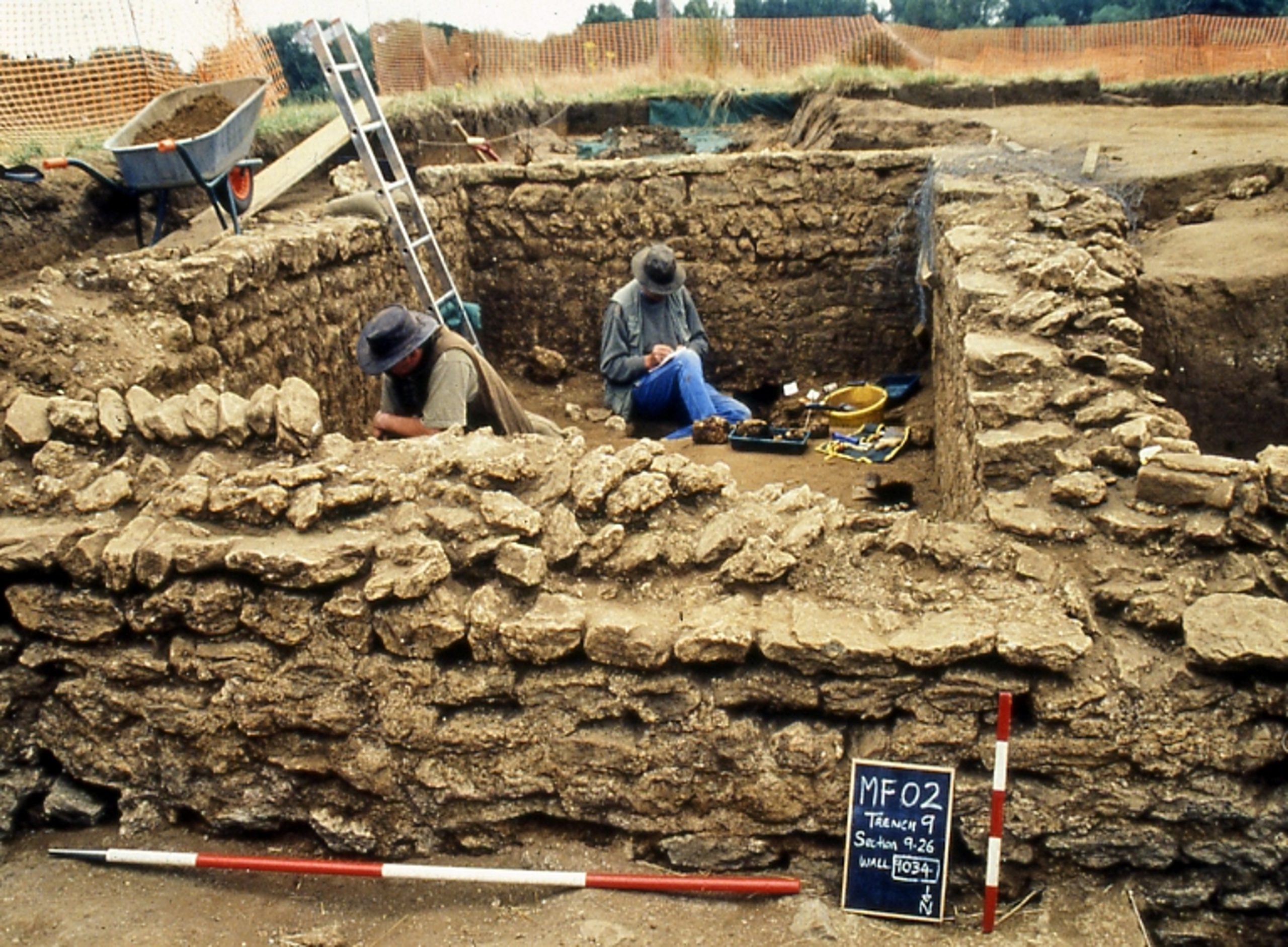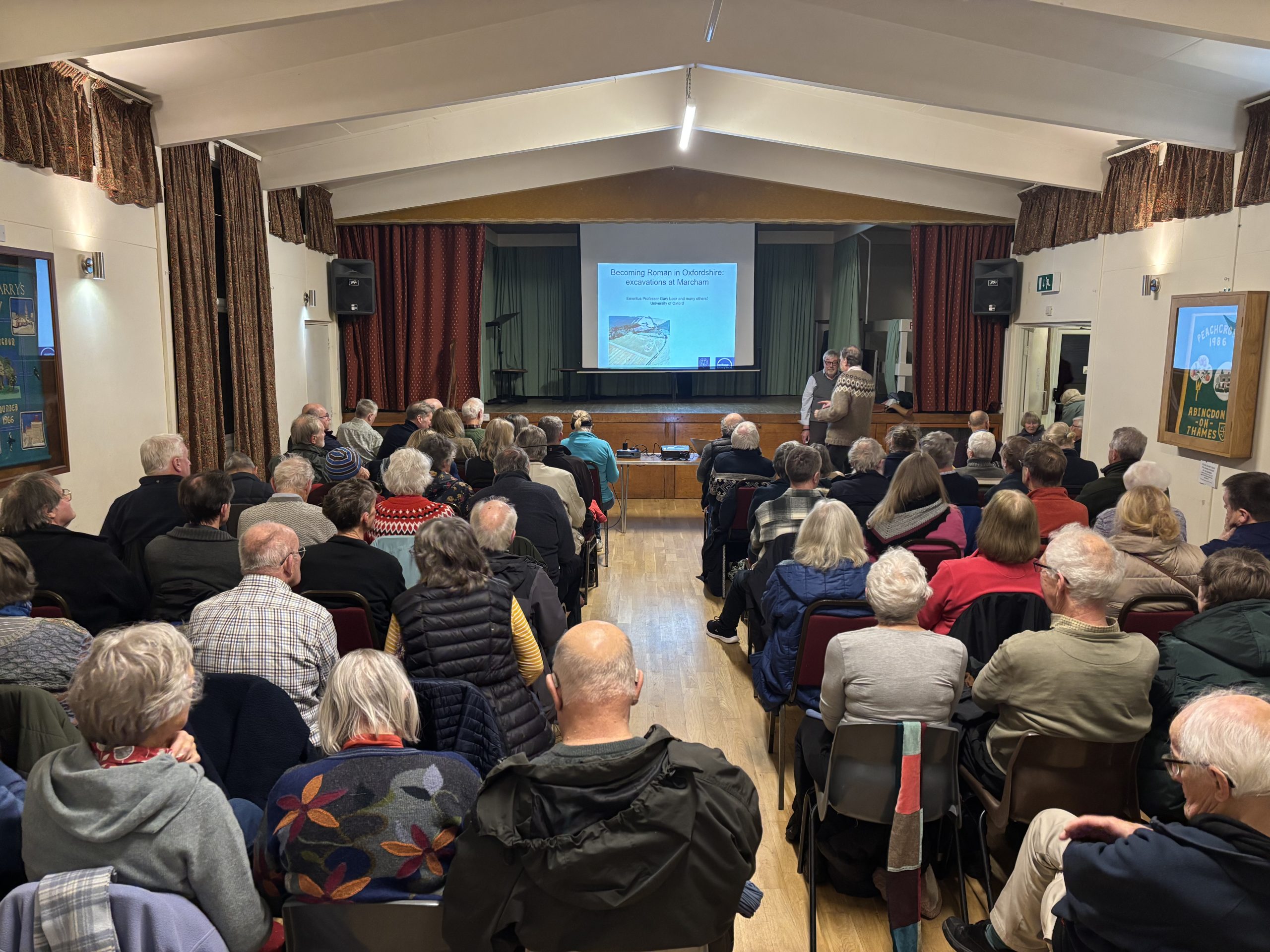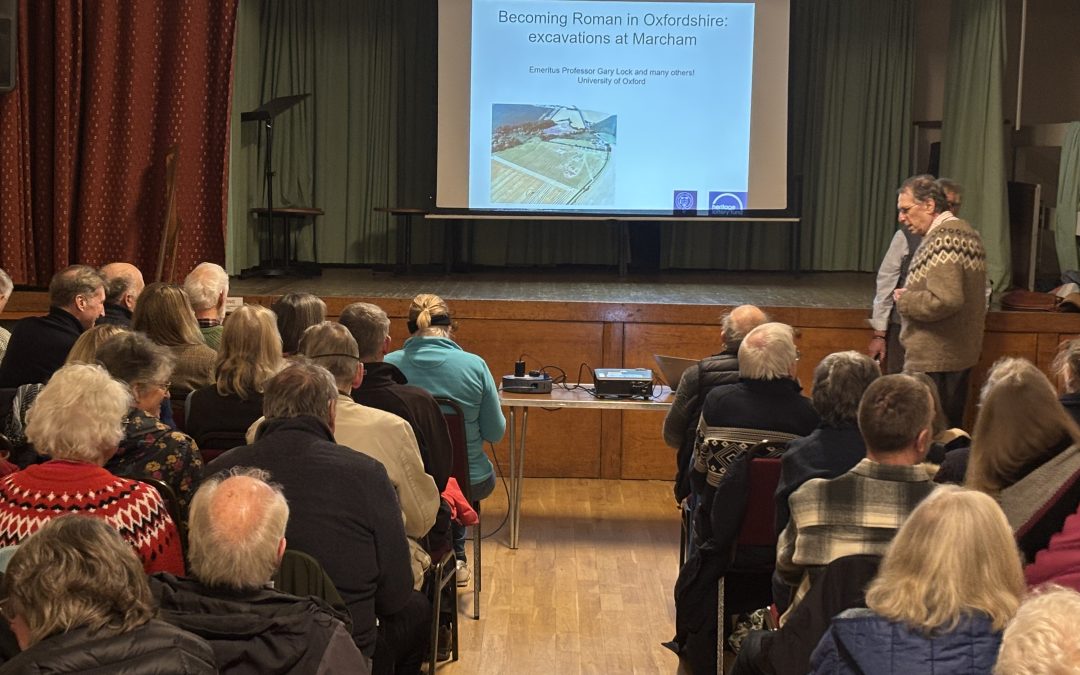
On Thursday 15 January, the Society welcomed Gary Lock, Emeritus Professor of Archaeology at the University of Oxford, to speak about the long-running excavations at Marcham and their remarkable evidence for religious continuity across millennia.
The site lies in and around the garden of what was once the Noah’s Ark pub at Marcham, now a private residence. Archaeological interest in the area stretches back to the early 20th century, when gravel extraction revealed a late Roman and early Saxon cemetery. Further investigations followed in 1937–38, when reports of Roman artefacts on the pub bar led Bradford and Goodchild to excavate a Romano-Celtic temple, although its stone walls had largely been robbed away.
A major breakthrough came in 1976 with the discovery of a circular cropmark in a nearby field known as Trendles — a name derived from Old English meaning “circular”, suggesting the feature had long been recognised in the landscape. Later excavation revealed this to be a stone-built semi-amphitheatre: not fully circular, but with seating curving around a central space and a stage-like area at one end.
Eleven seasons of modern excavation led by Professor Lock and colleagues revealed activity spanning the Bronze Age, Iron Age, and Roman period. Central to the interpretation of the site are the themes of memory and continuity. Evidence suggests an initially natural place of Iron Age worship — possibly linked to water or the nearby river — later formalised into a public Romano-British temple complex. Iron Age pits aligned eastwards, containing offerings, were deliberately incorporated into the Roman temple design, with the central votive shaft positioned precisely between them.
Finds included hundreds of fourth-century coins and thousands of hobnails, strongly suggesting the temple was dedicated to Mercury, god of travel and trade. The presence of a shop and café on the edge of the enclosure indicates the site drew visitors from far afield. The semi-amphitheatre nearby may have hosted religious performances or festivals, and a stone-lined drain leading towards the river appears to have been used for votive deposition.
Romano-British burials dating to the end of Roman Britain perhaps mark the site’s final phase of use. Further analysis, including isotope work on the human remains, is planned. A project website and data archive are expected to be released in 2026, allowing wider access to the continuing results of this extraordinary excavation.
Gary worked alongside an enormous team of archaeologists and volunteers, and praised their dedication to this incredible dig.