On 18 September 2025, members were treated to a richly local and eye-opening talk by architectural historian David Clark, exploring the hidden medieval fabric concealed behind many of Abingdon’s familiar streetscapes.
David began by reminding us that while Abingdon is well known for its major historic buildings, some of its oldest surviving structures are tucked away behind apparently ordinary façades. The talk encouraged a shift in how we look at the town — not just at what is visible at street level, but at what survives above, behind, and within.
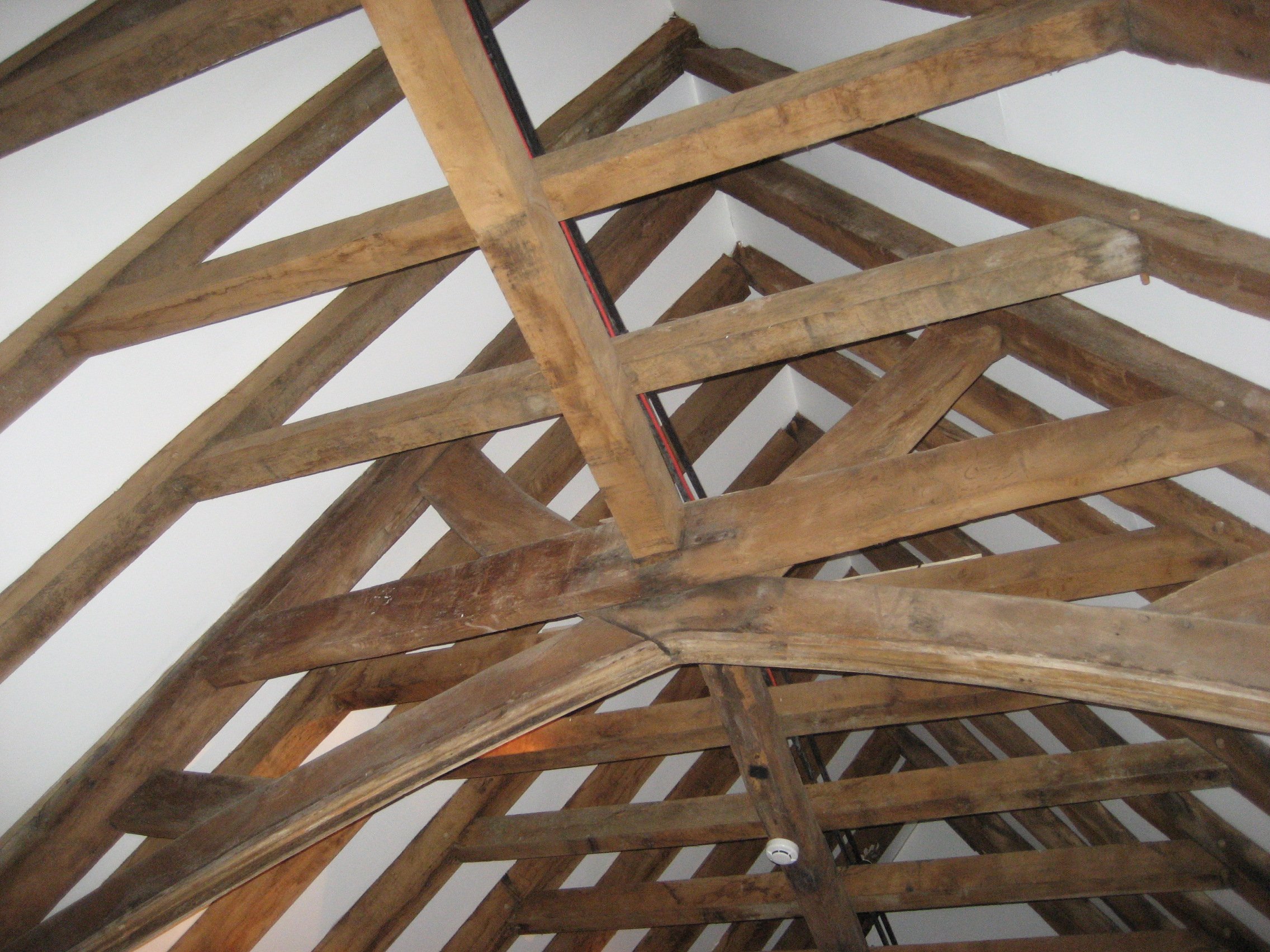
One key example was 15 High Street, now home to Dorindo’s restaurant and formerly part of the Lion pub complex. Behind its later frontage lies a building dating to 1291. Its roof reveals a rare and early response to racking — the sideways movement of a building over time — through the use of a crown-post roof, a medieval timber structure in which a central vertical post supports the roof frame. Dendrochronology (tree-ring dating) has confirmed the building’s early date, while evidence shows the roof was later rebuilt in 1501 using scissor bracing, a crossed timber arrangement designed to improve stability.
David noted that medieval attitudes to roofs differed markedly from later fashions. In the Middle Ages, fine roof carpentry was often deliberately left visible as a display of craftsmanship and status, whereas later periods preferred to conceal these structures.
A comparable survival can be seen at the Grapes pub, dating to 1299, where another crown-post roof survives. Here, there may also be evidence of cob walls — construction using earth mixed with organic material — and battered walls, which slope slightly inwards as they rise, a technique that improves stability and sheds water.
A recurring theme of the talk was that the roof is often the oldest surviving element of a building, making it crucial for dating and interpretation. David also highlighted practical clues for “reading” buildings: chimney stacks rarely move, even when interiors are altered, and the existence of upper floors always implies staircases, whether or not they survive. Interpreting historic buildings, he suggested, is fundamentally an exercise in detective work — reconstructing how spaces once functioned and how structures evolved over centuries.
The talk offered a fascinating glimpse into Abingdon’s concealed medieval past and left many attendees keen to walk the town with newly attentive eyes.